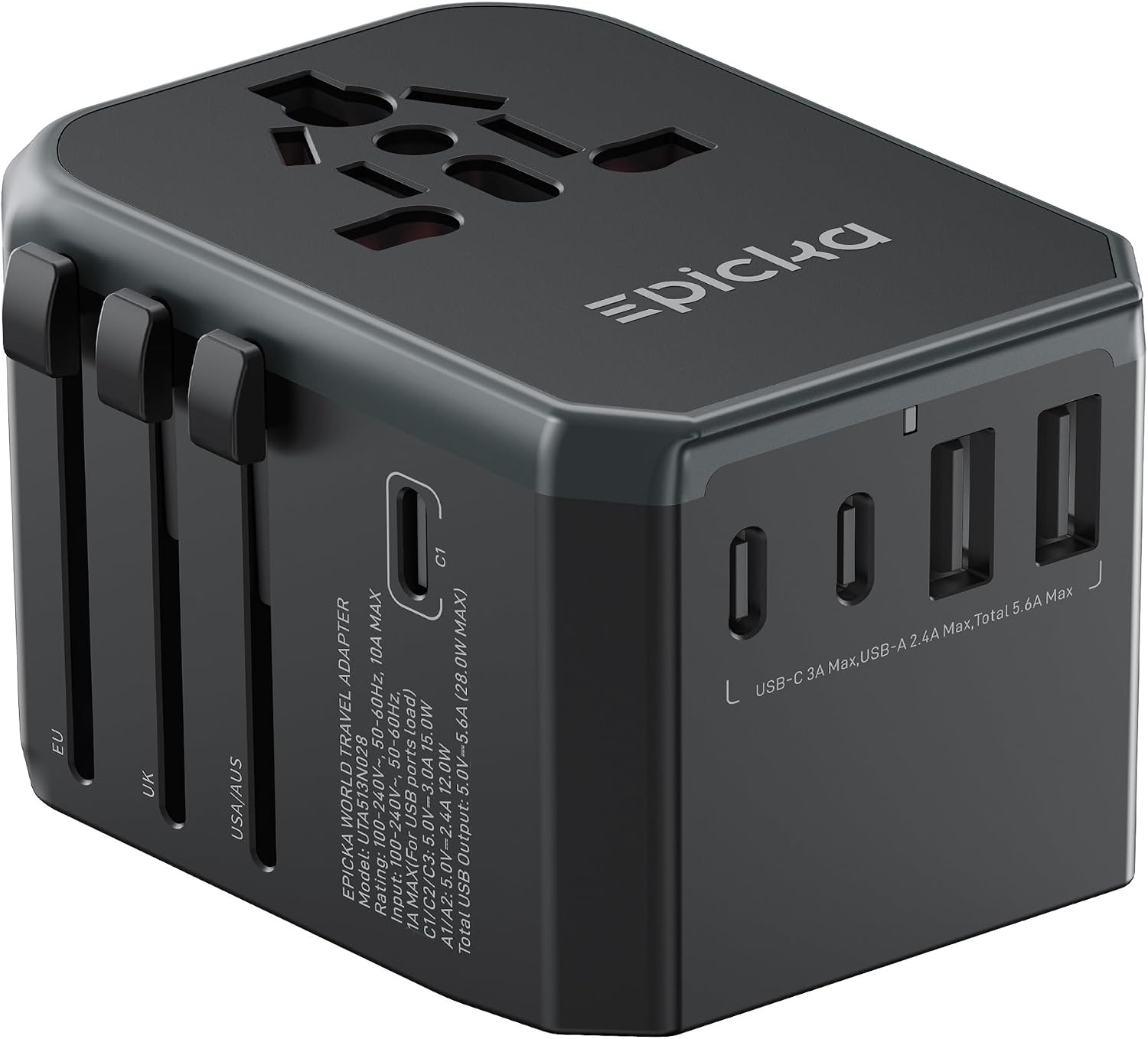
When you travel outside the United States, one of the easiest details to overlook is how your devices will plug into a foreign outlet. The short answer is that most small electronics need only a plug adapter, while high-wattage appliances such as hair dryers may need a voltage converter or should stay home. The longer answer depends on the label on each device.
What an Adapter and a Converter Each Do
A plug adapter is a small, lightweight piece of plastic that lets your plug physically fit into a different outlet shape. It does not change electricity. If your device is rated for the voltage at your destination, an adapter is all you need. If your device is not rated for that voltage, the adapter will not protect it.
A voltage converter changes the voltage from the wall outlet to a level your device can accept. It can step voltage up or down, but it is heavier than a simple adapter and usually has a wattage limit. That limit matters for high-power appliances like hair dryers, which may draw more power than a lightweight converter can safely handle.
| Item | What it changes | When you need it |
|---|---|---|
| Plug adapter | Shape of the prongs | Your device is rated for the destination voltage |
| Voltage converter | Mains voltage | Your device is not rated for the destination voltage and fits within the converter’s wattage limit |
| USB wall charger | Converts wall voltage to USB power | Your device charges through USB and the charger is dual voltage |
How to Read the Label on Your Charger
Find the input rating
Look at the plug brick, wall charger, or the label printed on the device itself. Search for the word “Input” or “INPUT.” This tells you what voltage the device is designed to accept. It is often printed in small text, so you may need good light and a pair of reading glasses.
Look for a voltage range
A label that says “100-240V” means the charger is dual voltage. It accepts both the lower voltages common in the United States and the higher voltages common in many other countries. Devices with this label need only a plug adapter when you travel internationally. The label may also list “50/60Hz,” which is fine for most small electronics.
If the label lists only one voltage
A label that says only “120V” or only “220-240V” means the device is single voltage. Plugging it into a wall outlet with the wrong voltage can damage the device or create a safety risk. You would need a voltage converter if the destination voltage is different, but only if the wattage rating works with the converter.
Dual-Voltage Devices
Most modern chargers for phones, tablets, laptops, cameras, e-readers, smartwatches, and portable batteries are dual voltage. This is common because compact switching power supplies can work across a wide range of voltages without becoming large or heavy. Even so, you should not assume every charger works worldwide. Check each charger individually, especially for older devices and small accessories.
Some devices have the voltage rating printed on the device itself rather than on a separate charger. Electric shavers, travel toothbrushes, and some camera battery chargers may have a label with a voltage range. If the label is missing or impossible to read, check the manufacturer’s instructions before you plug it in.
Hair Dryers and Other Heating Appliances
Hair dryers, curling irons, hair straighteners, and other heating appliances are the common exception to the dual-voltage rule. They often draw high wattage and are frequently rated for only one voltage. A 120V hair dryer plugged into a 220V outlet will heat too quickly and may burn out the heating element. A 220V hair dryer plugged into a 120V outlet may heat weakly and strain the motor.
A plug adapter does not solve this problem because it does not convert voltage. A voltage converter can help, but the converter’s wattage rating must be higher than the appliance’s wattage rating. Many lightweight travel converters are not designed for high-wattage hair styling tools. For most trips, a dual-voltage travel hair dryer, curling iron, or straightener is a simpler choice. You can also use a hair dryer provided by your hotel or buy one at your destination if space allows.
Plug Types by Region
There is no single international plug standard. Each region uses one or more plug shapes, and some countries use several. Always confirm the exact plug type and voltage for your specific destination before you leave.
| Region examples | Common plug types | Common voltage |
|---|---|---|
| United States, Canada, Mexico, Japan | Type A and Type B | 100-127V |
| Most of Europe, including France, Germany and Spain | Type C, Type E, Type F | 220-240V |
| United Kingdom, Ireland, Malta, Malaysia | Type G | 220-240V |
| Australia, New Zealand, China, Argentina | Type I | 220-240V |
If you visit one country regularly, a simple adapter for that plug type may be enough. If you travel to multiple regions, universal travel adapters cover many common plug shapes in a single unit. Before buying one, check whether it supports three-prong grounded plugs if your devices require grounding.
USB Charging as a Simpler Option
Many travel electronics can charge through USB, which simplifies the voltage question. Phones, tablets, earbuds, e-readers, handheld fans, and many cameras all charge with a USB cable and a USB wall charger. The wall charger converts the main voltage into safe USB power, so if that charger’s input label reads “100-240V,” you only need a plug adapter for the charger itself.
A portable power bank can also keep devices charged while you are out for the day, so you do not need to find an outlet. When you fly, remember that power banks and other spare lithium batteries are generally allowed in carry-on baggage rather than checked baggage. This is general guidance, so check the current TSA guidance on power banks and your airline before travel. You can also review the power bank on a plane rules for more detail.
Safety
- Check the voltage rating on every device before plugging it into an unfamiliar outlet.
- Use a plug adapter only if the prongs fit properly. Do not force a plug into an outlet.
- Never rely on a plug adapter to convert voltage.
- Do not overload outlets or plug multiple high-wattage appliances into one adapter.
- Inspect chargers, cords, and adapters for damage before you pack them.
- If a device feels unusually hot or smells strange, unplug it immediately.
- Follow the manufacturer’s instructions and warning labels for every electrical item.
Voltage converters are not a universal solution. If a converter’s wattage rating is too low for the appliance, it can overheat. If you are unsure whether a device is compatible with the electrical system at your destination, leave the device at home or buy a version made for international travel.
FAQ
Can I use a voltage converter with a hair dryer?
Usually not safely. Hair dryers draw high wattage, and most lightweight travel converters are not built for that load. Check the wattage on both the converter and the appliance, but a dual-voltage travel hair dryer is often the easier and lighter option.
How do I know if my phone charger is dual voltage?
Read the label on the charger. Look for the input rating and check whether it says “100-240V.” If the label only lists one voltage, the charger is not designed for worldwide use.
Will a plug adapter change 220V to 110V?
No. A plug adapter only changes the shape of the prongs. It does not convert voltage. If your device is not dual voltage, you need a voltage converter or a different device.
Do I need a travel adapter for USB cables?
The USB cable itself does not need an adapter. The wall charger that supplies the USB power may need a plug adapter if its plug shape is different at your destination. Some outlets and hotel rooms have USB ports, but you should not rely on them.
For most travelers, the answer is a simple plug adapter for a few dual-voltage chargers. Heating appliances are the exception, so read every label and pack accordingly. To keep the rest of your trip organized, work through the international travel checklist before you go.